What is the Spring Bird Census?
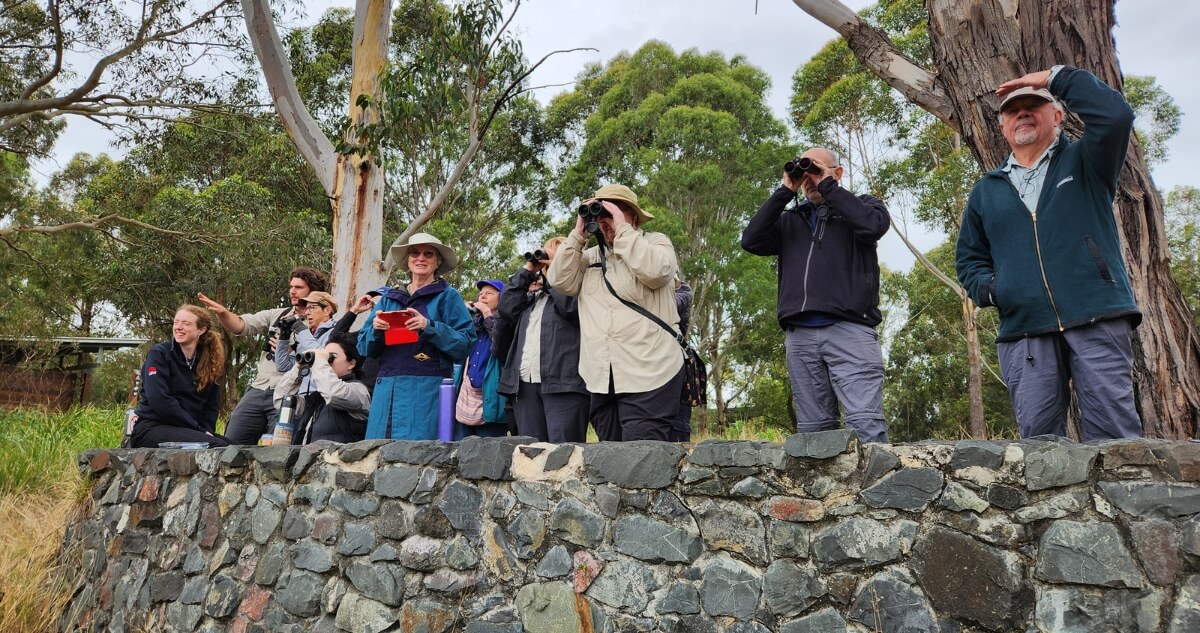
We’ve recently completed the 22nd annual Spring Bird Census 2025 at Sydney Olympic Park. These surveys are conducted in spring every Tuesday morning for 8 weeks, and cover 44 locations, with the help of 45 volunteers from the Cumberland Bird Observers’ Club.
Why do we need it?
Keeping track of the health of ecosystems can be a challenging task, particularly in urban areas where increasing development, disturbance, and pest species present extra challenges. One way to monitor overall ecosystem health is via bioindicators—species that are sensitive to environmental change and can represent the overall condition of an ecosystem. Birds serve as important bioindicators, as they are relatively easy to detect and are sensitive to their environment. Spring is an important time to monitor bird populations as it not only captures bird numbers, but also the species that are breeding on site. This is why our annual Spring Bird Census is so important in providing a snapshot of the condition of our Park and guiding future management directions.
What did we find?
We documented a total of 101 species across the Parklands, which represents almost half of the 220 species ever recorded at Sydney Olympic Park. Of the 101 total species, 95 species were natives. On average, 77 species were recorded each week, which captures species from a diverse range of bird groups, including waterbirds, parrots, honeyeaters, and woodland birds to name a few.
In total 19,051 birds were counted this Census, with a weekly average of 2,381 birds. The greatest abundance of birds was recorded in our larger waterbodies, the Waterbird Refuge, Lake Belvedere, and the Northern Water Feature, where waterbirds like Grey Teal, Chestnut Teal, Eurasian Coot, and Pied Stilts can flock in large numbers.
Top 10 most abundant species
| Species | Average Weekly Count |
|---|---|
| Noisy Miner | 192 |
| Grey Teal | 190 |
| Chestnut Teal | 159 |
| Superb Fairy-wren | 149 |
| Australian White Ibis | 136 |
| Eurasian Coot | 135 |
| Welcome Swallow | 107 |
| Pied Stilt | 107 |
| Rainbow Lorikeet | 101 |
| Silver Gull | 85 |
Were any species breeding?
You bet they were! We found evidence of breeding in 32 species with possible breeding recorded for another 11 species. Breeding was found in species from a range of bird groups, including waterbirds, woodland birds, honeyeaters, and parrots.
Nests ranged from the more obvious, such as the huge mounds the Australian Brush-turkey creates or the large nest clusters the Australian White Ibis build, to hollow nesting species, that are harder to detect, or small, well-camouflaged nests that Superb Fairy-wren and Red-browed Finches make in trees, shrubs and grass.


IMPORTANT REMINDER! When birds are nesting, they are particularly sensitive to disturbance and may leave their nests if they feel threatened. We ask that everyone keeps your distance if you see a nest and don’t take photos as this can scare the birds and their chicks.
Any stand outs?
Raptor Refuge: Six species of raptor were recorded during the Census, including the Black-shouldered Kite, Brown Goshawk, Collared Sparrowhawk, Nankeen Kestrel, Pacific Baza, and White-bellied Sea Eagle! The Brickpit was the most popular for raptors, with half the species recorded there.
Honeyeater Haven: Six honeyeater species were recorded: White-plumed Honeyeater, Brown Honeyeater, New-Holland Honeyeater, Red Wattlebird, Little Wattlebird, and Noisy Miner (although the Noisy Miner is adapted to urban environments). Narawang Wetland was a standout for honeyeaters with four of the six species present.
Parrot Paradise: We recorded twelve parrot and cockatoo species: the Sulphur-crested Cockatoo, Yellow-tailed Black Cockatoo, Galah, Short-billed Corella, Long-billed Corella, Australian King Parrot, Crimson Rosella, Eastern Rosella, Red-rumped Parrot, Rainbow Lorikeet, Musk Lorikeet, and Scaly-breasted Lorikeet.
Other notable species: Four species not often recorded at Sydney Olympic Park were seen in 2025. In the Brickpit, we saw a Dusky Woodswallow, Brown Cuckoo-Dove, and White-winged Triller, which haven’t been observed in the Park since 2017, 2012, and 2023, respectively. Two Topknot Pigeons, not seen since 2023, were recorded feeding on figs in Bicentennial Park.

Want to join next year?
The Census provides a great opportunity to meet like-minded people and learn more about birds. New volunteers are always welcome to join our partners from the Cumberland Bird Observers’ Club.

You might also be interested in...


The Bombardier Beetle (Pheropsophus verticalis) belongs to the ground beetle family (Carabidae).


If the Noisy Miner and the Common Myna entered a bird lookalike competition, they'd almost certainly make the final.